
The National FabricM · Revealed Preferences
M7M
Four-Car Couples
Two adults, four registered vehicles, and a metropolitan area that has made the first two mandatory and the last two a personality.

Reference marketFirst identified in Frisco, Texas (ZIP areas 75035, 75034, 75033, 75036).
Also found inMcKinney, Texas; Chandler, Arizona; Kennesaw, Georgia; Layton, Utah.
Thesis
A two-person household has assembled a four-vehicle fleet in a place that offers no alternative to the first two, then prices the remaining two as identity and the whole arrangement as freedom.
More vehicles than residents, no transit within reach.
Portrait
In their own words
- Age38
- Income$196K
- Net worth$141K
- Education62%
- Home$605K
- Ownership81%
- HouseholdTwo adults, one dog, four vehicles
- VehicleTwo dailies, one weekend car, one described as a project
- Debt$1,410 a month across four notes
- Vice
- Garage capacity
- Most likely to
- Take two cars to the same restaurant, from the same house, at the same time
- Signals
- A ceramic coating appointment, a second insurance policy, a battery tender
Who they are
This household registers 3.7 vehicles against 2.1 residents. Median household: $196,000 in combined income, $141,000 in net worth, and $1,410 a month across four notes, of which $438 covers a car driven 1,900 miles a year. Two of the vehicles are load-bearing, because the metro provides no alternative — transit share is at the 3rd percentile and the nearest stop is 6.4 miles away, in a direction the household has never established. The third is a weekend car that is photographed more than it is driven. The fourth is a project at 62 percent completion, unchanged since 2022, occupying a bay that costs $310 a month in mortgage on a square-foot basis. Asked why, the household says it likes having options, which is true, and does not describe what the options cost.
Our neighborhood
Post-2012 master-planned Collin County, four bedrooms for two people, three-car garage with a fourth vehicle on the pad because the HOA permits it for ninety days at a time. Every destination is a left turn onto a six-lane arterial and a right into a lot. The grocery store is 1.4 miles away and the sidewalk stops 400 feet short of it, which resolves the question of whether anyone walks. Nothing in the range of the house was built with the assumption that a person might arrive at it any other way.
Shopping
Purchases are made in the vehicle category and then defended in every other category. Ceramic coating at $1,900, a second insurance policy at $141 a month, a wall-mounted tool chest, and a compressor that has inflated four tires. Groceries arrive by pickup order, loaded into a vehicle by an employee, which is the one transaction in the week where a car is genuinely required and the least enjoyed. The house is furnished from two rooms of a showroom and the third bedroom is empty.
Spending
A $196,000 income producing $141,000 in net worth, because $1,410 a month exits as auto notes and another $390 as insurance and registration on four units. Depreciation runs an estimated $11,000 a year and is never counted, on the grounds that it is not a bill. Both adults contribute to a 401(k) at 4 percent. The weekend car is described as an appreciating asset and has depreciated 18 percent since purchase.
Media
Marketplace listings browsed nightly at a volume that constitutes a hobby, two detailing channels, and a forum for a model neither adult owns yet. Podcasts are consumed exclusively in transit, which means the household's media diet is a direct function of the length of the arterial. Nobody here has finished a book since the second car.
Interests
Cars and Coffee on the first Saturday, a track day booked once and rescheduled twice, and a running renovation of the garage that has now exceeded the renovation budget of the house. The couple describes itself as into cars, which is accurate, and as free, which is the part the data disputes: in a metro with a 3rd-percentile transit share, three of the four vehicles are a choice and the first one never was.
Where they live
Darker is more of them.
M7 · FOUR-CAR COUPLES
ZIP CODES
—
How thick on the ground
$96K
Median household income
1.33× the national median
$426K
Typical home value
1.60× the national median
4.3×
Home value against income
1.14× the national median
38%
Bachelor's degree or higher
1.65× the national median
75%
Owner-occupied
Share of occupied units
$1,730
Median gross rent
Monthly, contract plus utilities
2.58
Average household size
Persons per occupied unit
40.8
Median age
Years
How they compare
Against the average American household.
Median household income
1.33×
$96K here$72K everywhere else
Typical home value
1.60×
$426K here$266K everywhere else
Bachelor's degree or higher
1.65×
38.3% here23.2% everywhere else
Home value against household income
1.14×
4.30× here3.77× everywhere else
Who lives next door
Household types that turn up on the same blocks.
 M8HomeGoods Wine MomsThe one affluent household where the house does not eat the raise, and the difference is spent within four miles of the driveway.
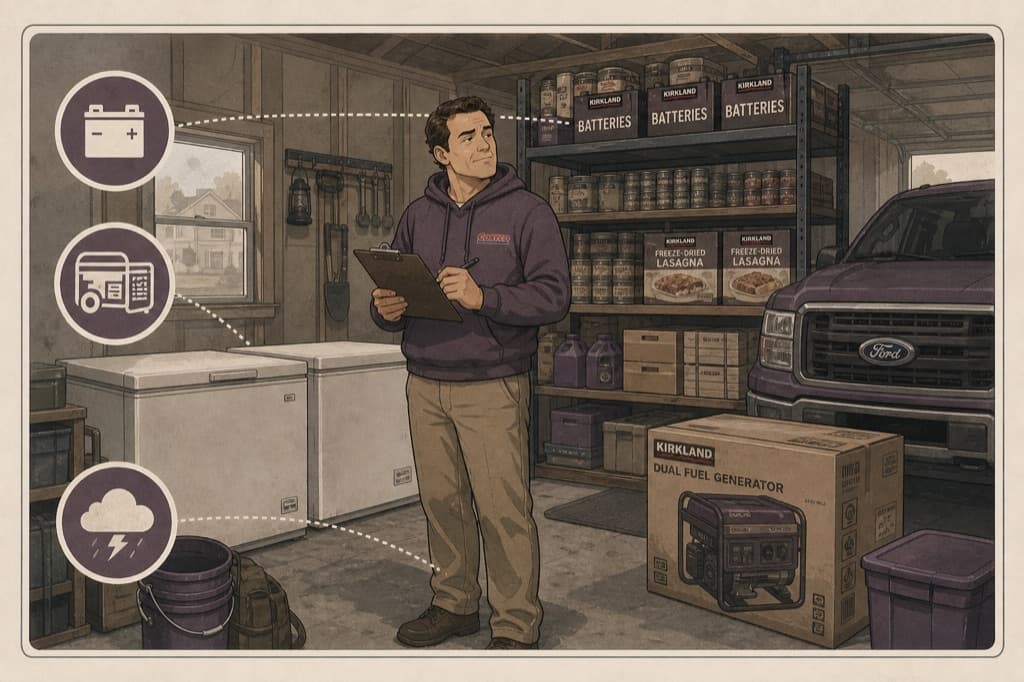 B5Costco DoomsteadersPrepper-lite. A few months of freeze-dried lasagna and a generator.
 M3Empty-Nest EstatesSix bedrooms, two occupants, four vehicles, and a plan to downsize starting soon.
 M5McMansion MartyrsTop-decile earners who converted the entire raise into square footage and now describe themselves, without irony, as house-poor at $268,000.
 B2MegaChurch Industrial ComplexWorship in a converted Walmart with a fog machine, coffee bar, and merch table.
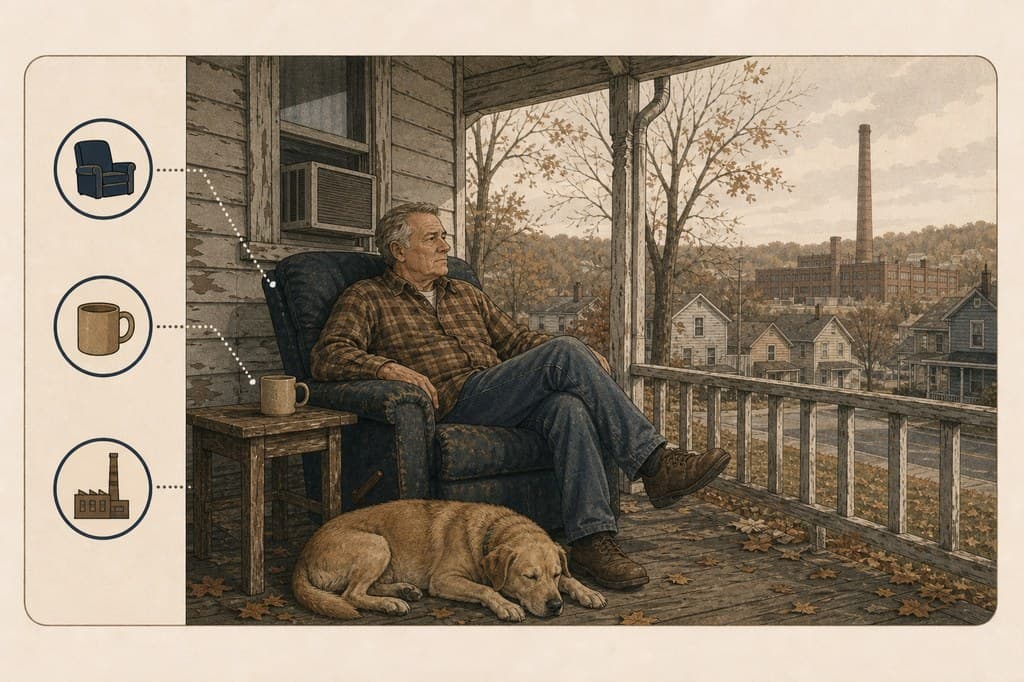 L5Rust & ReclinerA paid-off house in a town whose largest employer is now the hospital that treats the people the last employer injured.
The receipts
- 01Vehicle intensity beyond what the setting requires75th0.24
- 02Rural-urban continuum position12th0.05
- 03Households over $200,00071st14.9%
- 04Built since 201072nd16.4%
- 05Average household size61st2.58
- 06Commutes by transit43rd0.1%
- 07House consumed against household occupying it55th1.18
- 08Bedrooms per resident55th1.18
- 09Walks or bikes to work44th1.2%
- 10Households with three or more vehicles47th26.2%
SourcesFigures from the U.S. Census Bureau, the Department of Agriculture and MoneyHole Research. Everything else is observation.